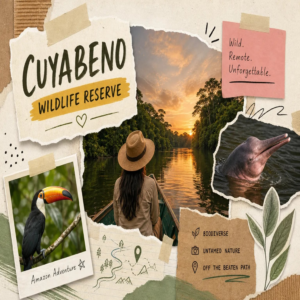
Picture this in the Cuyabeno Wildlife Reserve: your canoe drifts across a black-water lagoon as the last light disappears. Pink river dolphins surface near the boat while howler monkeys call from the forest. You’re in the Ecuadorian Amazon, and this is a normal evening in Cuyabeno.
Cuyabeno Wildlife Reserve covers 590,112 hectares of protected rainforest in northeastern Ecuador, near the border with Peru. It was officially decreed in 1979 and expanded to its current size in 1985. This guide covers when to visit, how to get there, what you can see, and how to choose the right lodge.
There’s also a backstory here worth knowing. The scientist who proposed the reserve’s creation later built a lodge directly on its most iconic lake. That lodge, CUYABENO LODGE, BEING FIRST, WE CHOSE THE BEST SPOT, is still operating today, and understanding why it was built where it was built tells you something important about how to choose your base for this trip.
What Cuyabeno Wildlife Reserve actually is
The reserve sits in the upper Amazon basin, northeast of Quito. It is defined by blackwater rivers and an interconnected system of lagoons rather than solid jungle floor.
Officially known as the Reserva de Producción Faunística Cuyabeno, it is a wildlife production reserve designed to combine habitat protection with sustainable human use by Indigenous communities.
Its defining feature is flooded forest. Large areas of igapó and várzea forest are seasonally or permanently affected by water. This makes the waterways important wildlife corridors. Monkeys move through the canopy above the canoe, while birds and other animals concentrate around the water.
Cuyabeno has more than 550 recorded bird species and 10 primate species, making it particularly rewarding for wildlife watchers.
The scientist who created the reserve, and then built a lodge on it
In the late 1970s, Dr. Daan Vreugdenhil, a conservation ecologist with a PhD from Wageningen University in the Netherlands, was working as a UN and FAO consultant tasked with designing Ecuador’s protected areas system. His fieldwork and scientific recommendations directly shaped the 1979 FAO report that led to Ecuador formally decreeing 39 protected areas, including the original Cuyabeno reserve. When an invasion into the upper watershed threatened the reserve’s integrity in 1983, Vreugdenhil and colleagues proposed a strategic redefinition: exclude the compromised zones, extend the boundaries south to the Peruvian border. The result was the 590,000-hectare reserve that exists today.
After helping to create the reserve, Dr. Vreugdenhil didn’t move on to the next project. He built Cuyabeno Lodge directly on Lake Cuyabeno, the reserve’s most visually striking body of water, making it the original lodge in the entire protected area. This lodge uniquely carries that historical link to the reserve’s founding ecologist, a connection baked into its guiding philosophy, its island position on the lake, and the depth of ecological knowledge its guides bring to every excursion. Learn more about the lodge’s history and location at CUYABENO LODGE, BEING FIRST, WE CHOSE THE BEST SPOT.
In practical terms, the lodge’s location means guests step off the dock and are already on the reserve’s most productive wildlife water. The sunset viewing deck faces the lake directly. Pink river dolphins are often visible from the lodge’s waterfront vantage points. That’s not a coincidence; it’s the result of someone who knew exactly where to build.
Wildlife you’ll realistically see in Cuyabeno Wildlife Reserve
Pink river dolphins can frequently be seen during canoe outings, particularly around larger open-water areas. Black caimans are most commonly searched for during night canoe rides.
Cuyabeno’s monkeys include squirrel monkeys, woolly monkeys, and howler monkeys. Birds are another major attraction, with more than 550 recorded species.
Depending on the excursion, you may encounter:
- Pink river dolphins
- Black caimans
- Monkeys
- Hoatzins
- Macaws
- Toucans
- Kingfishers
- Herons
- River otters
- Peccaries and tapirs
Different activities offer different wildlife opportunities:
- Dawn paddle: birds and parrots
- Afternoon canoe safari: dolphins and primates
- Night canoe ride: caimans, amphibians, and owls
- Forest hike: understory birds, insects, and reptiles
Best time to visit Cuyabeno Wildlife Reserve and how to get there from the US
Cuyabeno operates year-round.
The rainy season, roughly February through July, raises water levels and provides greater access to flooded forest by canoe.
The drier period, roughly August through January, lowers water levels, improves trail access, and can make some reptiles easier to spot around exposed areas.
Travelers from the US normally fly to Quito first. From Quito, options include:
- Flight toward Coca, followed by ground transfer
- Direct shuttle from Quito to Cuyabeno Bridge
The best option depends on your itinerary, budget, and preferred travel time.
Cuyabeno Wildlife Reserve tours, itineraries, and choosing the right lodge
A typical 3-day itinerary includes arrival by canoe, a lake excursion, forest hiking, an Indigenous community visit, afternoon canoeing, and a night excursion.
However, 4 days is a better option for travelers who want more time in the reserve. A 5-day stay can be especially useful for serious wildlife observers because it provides additional opportunities to explore different habitats.
All-inclusive packages commonly include accommodation, meals, canoe transportation, guides, and reserve-related fees.
Lodge location matters
Many lodges are located along the Cuyabeno River, meaning guests may need additional boat travel to reach Lake Cuyabeno.
Cuyabeno Lodge is located directly on Lake Cuyabeno, providing direct access to the lake and reducing the amount of time spent commuting between the lodge and major excursion areas.
What to pack
Bring lightweight clothing suitable for a warm and humid rainforest environment:
- Lightweight long-sleeve shirts
- Lightweight trousers
- Insect repellent
- Waterproof bags for electronics
- Headlamp
- Lightweight rain jacket
- Binoculars
- Sunscreen
- Water shoes or sturdy sandals
Quality lodges provide accommodation, meals, and basic equipment such as rubber boots and rain protection.
Ready to book your Cuyabeno trip
Cuyabeno Wildlife Reserve combines black-water lagoons, flooded forest, wildlife, and Indigenous culture in one of Ecuador’s most distinctive Amazon destinations.
For travelers looking for more time on the water and direct access to Lake Cuyabeno, Cuyabeno Lodge’s island location offers a particularly direct way to experience the reserve.
Cuyabeno Lodge welcomes direct booking inquiries via WhatsApp +593 96 925 7630.